Design Projects Coding Projects Experiments / Arts Writing About Resume / CV ↗

Decoding Deception

Unveiling the micro-mechanisms of moral development via multimodal AI.

A long-term developmental psychology research project at Dr. Kang Lee's Laboratory, University of Toronto. Traditional research on children's deception relies on manual video coding — labor-intensive and subjective. We built an automated multimodal pipeline to analyse the behavioural dynamics of academic cheating, moving from macro-expressions (Phase 1) to micro-behaviours (Phase 2).

“Can we identify reliable, objective behavioural markers that distinguish spontaneous cheating from honest behaviour in children?”

Timeline
Mar 2025 – Present
Role
Research AssistantAI team
Lab
Dr. Kang Lee LaboratoryUniversity of Toronto
Keywords
PsychologyMachine LearningEmotion RecognitionDeepFaceMediaPipeRandom Forest
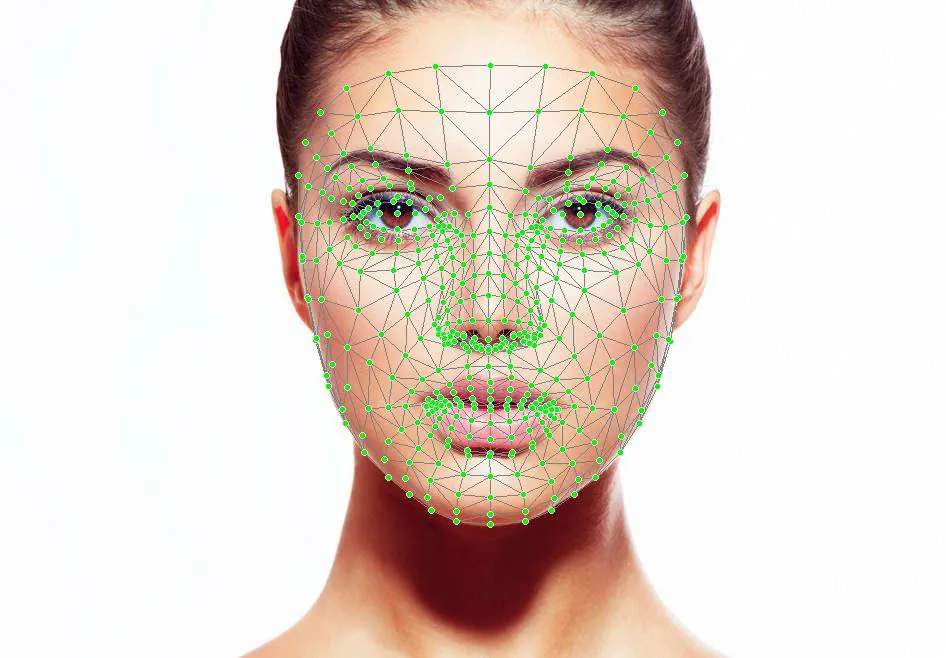
Facial landmark mesh over a face
588
children tracked for 3 years, ages 4–12
42M
video frames analysed
511
landmarks per frame: 478 facial + 33 body

01.Background

Dr. Kang Lee’s Laboratory at the University of Toronto is internationally recognised for its research in developmental psychology, moral behaviour, and the cognitive mechanisms underlying children’s deception. Prof. Lee’s team has pioneered experimental paradigms where children are observed in controlled settings to study lying, self-regulation and emotional expression.

I joined the lab’s AI team to develop computer-vision tools that analyse children’s facial expressions and body movements in deceptive versus honest conditions. Moving from macro-expressions (Phase 1) to micro-behaviours (Phase 2), we aim to map the developmental trajectory of honesty.

02.The Research Gap

Despite decades of work on academic dishonesty, studies still rely on self-reports or manual behavioural coding, methods that cannot capture the subtle, multimodal dynamics of moral decision-making. Most focus on adolescents in cross-sectional designs, leaving early childhood largely unexplored.

RQ1 · Macro level (Phase 1)Do visible expressive behaviours, such as smiling (“duping delight”) or face covering, differ significantly between cheaters and non-cheaters?
RQ2 · Micro level (Phase 2)Can multimodal AI detect subtle, high-dimensional micro-cues (e.g. landmark variance) that are invisible to traditional manual coding?

03.Phase 1 · Macro-Behavioural Markers

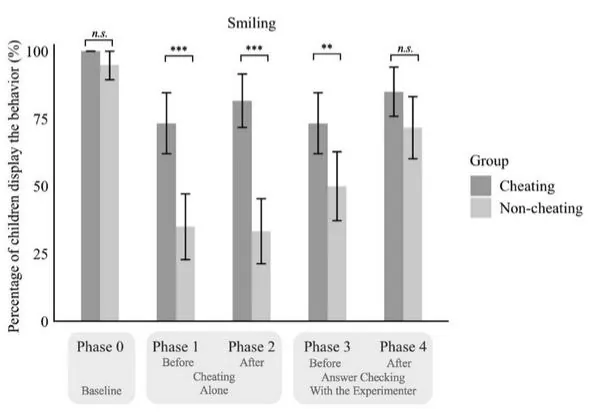
In the “peeping” paradigm, children (N=120) faced an impossible math problem alone while hidden cameras recorded spontaneous cheating. Bootstrapped chi-square analyses across four phases produced two findings.
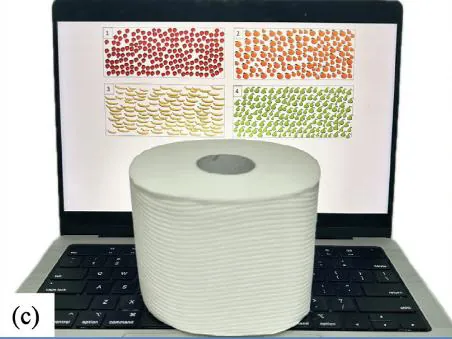
The peeping paradigm: a laptop showing fruit arrays with the answer hidden behind a roll
Finding 1 · Duping delightCheating children smiled significantly more after the transgression (p < .001): the thrill of getting away with it.
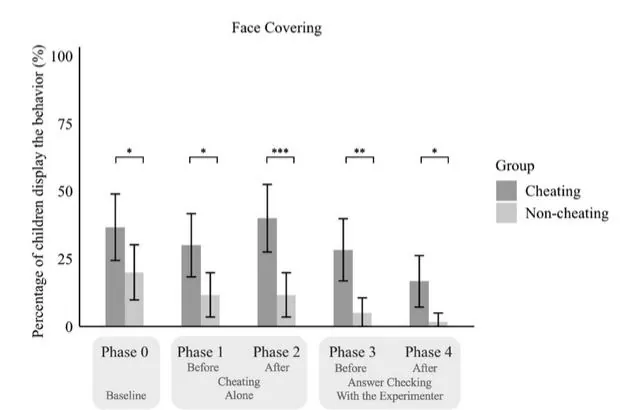
Finding 2 · Pre-emptive hidingCheaters covered their faces more often (p < .05) even before the opportunity to cheat arose.
Percentage of children smiling, cheating vs non-cheating, across phases
Percentage of children covering their face, cheating vs non-cheating

Bootstrapped chi-square results for smiling and face covering, Phase 0 (baseline) to Phase 4.

Manual coding caught these visible signals but missed the high-dimensional micro-cues. To bridge the gap we assembled a longitudinal dataset and extracted every stream automatically:

01Video478 facial landmarks + 33 body-pose landmarks and gaze, per frame, across 42 million frames.
02AudioSpeech transcription (Qwen) and eGeMAPS prosody: 88 acoustic features in 4 categories, 25 low-level descriptors.
03TraitsExecutive-function and personality surveys, parenting style, as static covariates.

04.Phase 2 · The AI Pipeline

Methodology

01Audio-visual video dataRecorded sessions from the longitudinal study.
02Feature extractionComputer vision (OpenFace, MediaPipe) for facial mesh and body landmarks; verbal features via LLMs and OpenSMILE; socio-cognitive traits.
03Specialised encodersST-GCN for mesh, BERT and MLP for speech, MLP for traits, fused by a central Transformer.
04OutputsHierarchical clustering into behavioural phenotypes, cheating / honesty prediction, and developmental trajectory modelling (LGCM).

Benchmark: existing children’s emotion recognition models

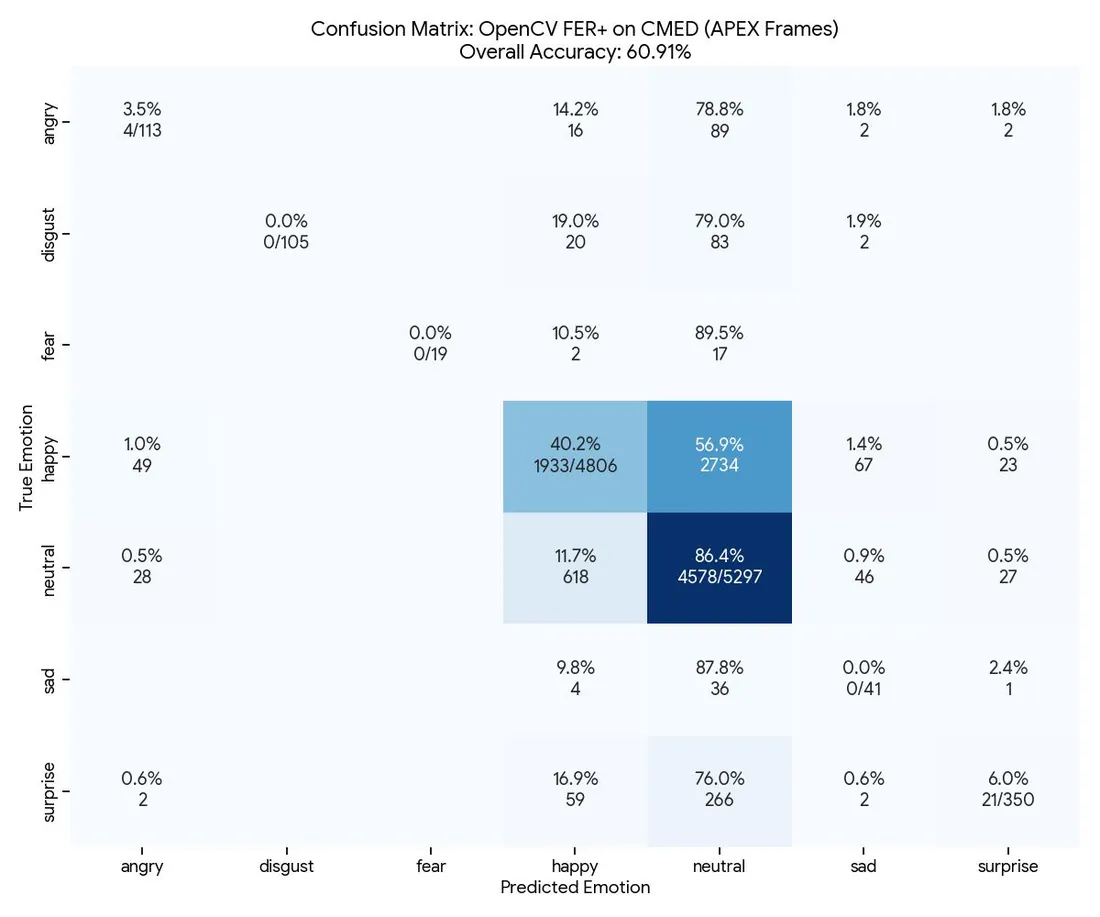
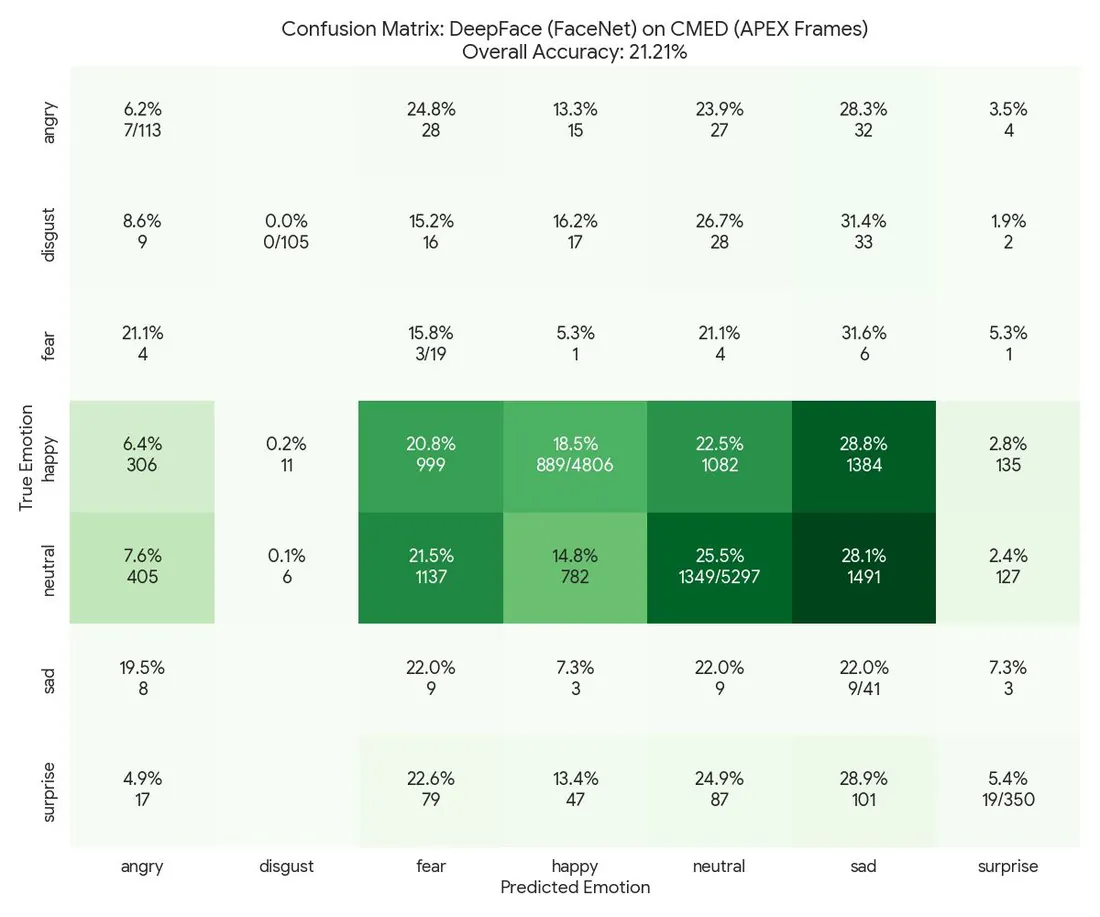
Feature extraction feeds a two-stage framework: children-specific emotion models first, then a Transformer fusion over the multimodal sequence. Before building a deception model we benchmarked state-of-the-art emotion recognisers on children’s faces (CMED dataset, 10,731 expressions).

60.91%
OpenCV FER+ (adult-trained)
biased toward “neutral”
21.21%
DeepFace FaceNet2
systematic bottleneck regardless of backend
88.57%
AFCNN, reproduced
children-specific architecture
Adult-trained models suffer a severe domain gap on children (21% vs 88%), demonstrating the need for children-specific architectures.Critical finding
Confusion matrix of OpenCV FER+ on children’s faces, 60.91% accuracy
Confusion matrix of DeepFace FaceNet2 on children’s faces, 21.21% accuracy

Benchmark confusion matrices: both adult-trained models collapse toward “neutral”.

05.AFCNN Reproduction & Validation

We reproduced the AFCNN model (Wang & Dong, 2025) for children’s emotion recognition. The architecture specifically targets the “wide-eyed” ambiguity in children’s faces.

Input80×80×3 RGB
→
Conv block 1Conv2D 32 · BatchNorm · ReLU · MaxPool 2×2 → (40, 40, 32)
→
Channel attention 1GlobalAvgPool · Dense(1, ReLU) · Dense(1, Sigmoid) · Multiply
→
Conv block 2Conv2D 64 · BatchNorm · ReLU · MaxPool 2×2 → (20, 20, 64)
→
Channel attention 2GlobalAvgPool · Dense(1, ReLU) · Dense(1, Sigmoid) · Multiply
→
Conv block 3Conv2D 128 · BatchNorm · ReLU · MaxPool 2×2 → (10, 10, 128)
→
Channel attention 3GlobalAvgPool · Dense(1, ReLU) · Dense(1, Sigmoid) · Multiply
→
ClassifierFlatten · Dense 256 · Dropout 0.5 · Softmax over 7 emotions
88.57%
overall accuracy of the reproduced AFCNN on children’s faces
21% → 88%
gap closed against adult-trained models
CLAHE preprocessingClip limit 3.0 enhances local contrast to reveal micro-expressions invisible in raw frames.
Scalar channel attentionUnlike SE-Net’s per-channel attention, AFCNN computes a single scalar weight (GlobalAvgPool → Dense(1) → Sigmoid) broadcast to all channels. It acts as a robust noise filter for low-resolution children’s faces, where per-channel attention is too noisy.

06.Contribution

1 · Observable behavioural markers for child deception detectionWe identified objective markers: macro-level (duping delight, p < .001) and micro-level (facial variance, prosody) from 42M frames. First age-specific baselines for children 4–12. Combines visible cues (parents, teachers) with AI-detected micro-cues (200–500 ms).
2 · Multimodal AI pipeline for psychological state assessmentA generalisable framework: 478 facial + 33 body landmarks + speech + 88 prosody features. Children-specific models with Transformer fusion and an interpretable two-stage design. Transfers to anxiety, depression and emotional regulation beyond deception.
3 · Broader clinical applicationsAn auxiliary diagnostic tool for mental health: facial, prosodic and body cues as objective biomarkers. A deployed chatbot validates real-time emotion recognition feasibility. Enables early detection (ages 4–7) and longitudinal therapy tracking.

07.Applications

Current

Another project in our lab assesses mental health using video and questionnaires, and employs this algorithm and related methods.

Future
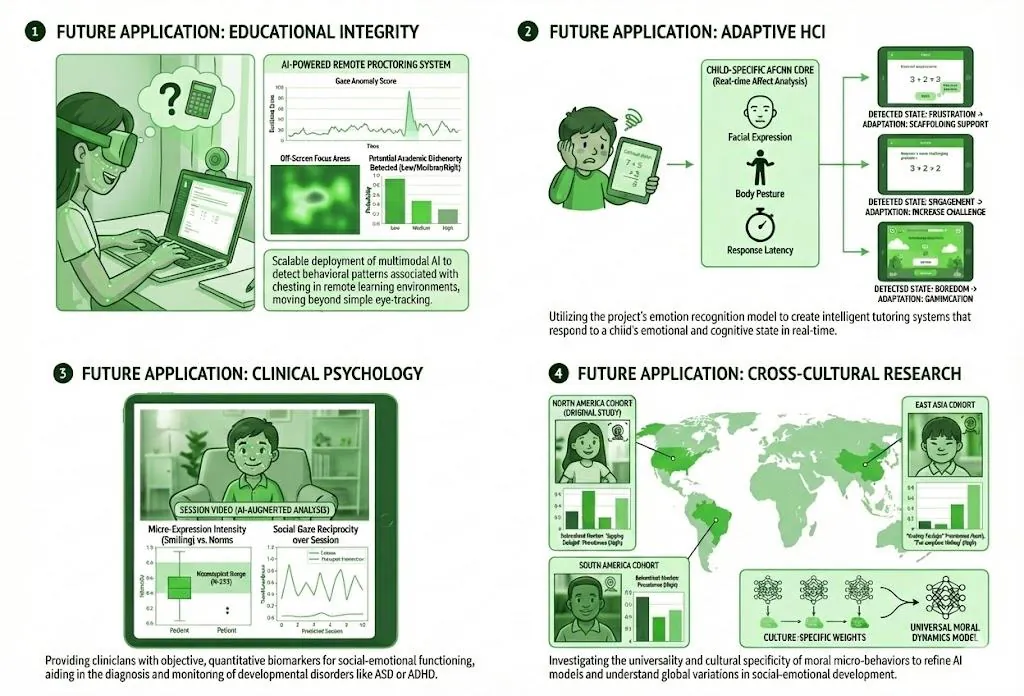
Educational integrityOnline testing environments.
Adaptive HCIAI tutors that detect frustration, confusion or dishonesty in real time, promoting mastery-based learning over performance pressure.
Cross-cultural researchCultural differences in moral development.
Illustrated future applications
Future applications: educational integrity, adaptive HCI, clinical psychology and cross-cultural research.